
1999 Botanical Survey of Midway | Starr Environmental
This comprehensive botanical survey, conducted from March 27 to June 30, 1999, by Forest and Kim Starr and their team, provides an updated inventory of plant species on Midway Atoll.
2006 New Plant Records from the Hawaiian Archipelago | Bishop Mus. Occas. Pap. 87
This field-based survey reports 19 new plant records across several Hawaiian islands—comprising one new state record and eighteen new island records. Predominantly non-native species, these findings reflect ongoing changes in the islands’ flora and provide essential data for ecological monitoring and conservation planning.
2008 Botanical Survey of Midway Atoll | Starr Environmental
Conducted during June 2008, the survey focused heavily on Sand Island—the primary area with non-native species—and included shorter field visits to Spit Island on June 3, 2008.
Images | Starr Environmental
Starr Environmental is the personal site of biologists and environmental consultants Forest and Kim Starr, based in Hawai‘i. Known for their extensive botanical and fauna surveys across the Hawaiian Islands, the Starrs have documented native species and habitats—especially on O‘ahu, Maui, and Hawai‘i—creating a rich repository of plant and insect images. Their content, often shared with generous permissions for educational and conservation use, supports scientific study, restoration projects, and public learning.
Modeling Future Change | U.S. Geological Survey
filterable list with links to pages containing details of different studies
Images – Pacific Island Ecosystems Research Center | U.S. Geological Survey
images of various plants and projects
Online Activities | Hō‘ike o Haleakalā
H??ike o Haleakal?
Community-Level Response to Change | U.S. Geological Survey
This USGS PIERC portal highlights ongoing research on how Hawaiian ecosystems—especially forests and plant communities—are responding at the community level to environmental shifts. Focus areas include climatic changes (e.g., drying trends, elevated temperatures), invasive species dynamics, and innovative monitoring approaches like plant physiology measures and environmental DNA (eDNA). There are strong links to climate-informed conservation strategies in Hawaiʻi.
Disease Ecology | U.S. Geological Survey
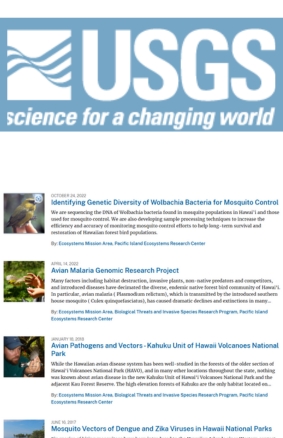
The Disease Ecology program at the U.S. Geological Survey’s Pacific Island Ecosystems Research Center (PIERC) focuses on how diseases and their vectors affect both wildlife and human health across Hawai‘i and other Pacific island ecosystems. It highlights the introduction of mosquito-borne avian malaria and pox virus—which have drastically impacted endemic Hawaiian birds—and models the risk of emerging human diseases like chikungunya and West Nile virus.
Endemic, Indigenous, or Non-Native? | Lyon Arboretum
slideshow detailing the differences between endemic, indigenous, and non-native plants