Images – Pacific Island Ecosystems Research Center | U.S. Geological Survey
images of various plants and projects
Online Activities | Hō‘ike o Haleakalā
H??ike o Haleakal?
Community-Level Response to Change | U.S. Geological Survey
This USGS PIERC portal highlights ongoing research on how Hawaiian ecosystems—especially forests and plant communities—are responding at the community level to environmental shifts. Focus areas include climatic changes (e.g., drying trends, elevated temperatures), invasive species dynamics, and innovative monitoring approaches like plant physiology measures and environmental DNA (eDNA). There are strong links to climate-informed conservation strategies in Hawaiʻi.
Disease Ecology | U.S. Geological Survey
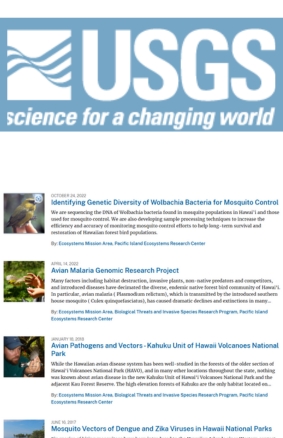
The Disease Ecology program at the U.S. Geological Survey’s Pacific Island Ecosystems Research Center (PIERC) focuses on how diseases and their vectors affect both wildlife and human health across Hawai‘i and other Pacific island ecosystems. It highlights the introduction of mosquito-borne avian malaria and pox virus—which have drastically impacted endemic Hawaiian birds—and models the risk of emerging human diseases like chikungunya and West Nile virus.
Endemic, Indigenous, or Non-Native? | Lyon Arboretum
slideshow detailing the differences between endemic, indigenous, and non-native plants
Harold L. Lyon Arboretum | A University of Hawaii Research Unit
informational page about Lyon Arboretum
Let’s Talk Native Plants! (VIDEO) | Lyon Arboretum
This educational video, created by Lyon Arboretum, serves as an engaging and accessible introduction to Hawai‘i’s native plant species.
Native Plants and Lookalikes – Google Slides | Lyon Arboretum
This comprehensive slide deck provides an engaging and educational look at Hawaiʻi’s native plant species, featuring clear explanations, visuals, and interactive elements suitable for classroom use, outreach, and self-study.
Native Plants and Lookalikes – Google Slides (with Audio) | Lyon Arboretum
This comprehensive slide deck provides an engaging and educational look at Hawaiʻi’s native plant species, featuring clear explanations, visuals, and interactive elements suitable for classroom use, outreach, and self-study.
Environmental History & Debate Lesson Plan – Lyon’s Dilemma | Lyon Arboretum
Lyon’s Dilemma is a two-day, role-playing debate activity that immerses students in a historical environmental crisis facing Honolulu in the early 20th century. Using archival context and primary source excerpts, students examine real-world conservation decisions surrounding water scarcity, forest degradation, and the introduction of non-native species.