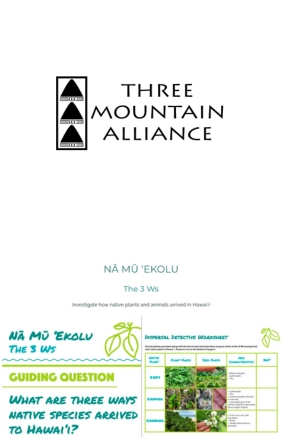
Nā Mū ʻEkolu (“The Three Ws”) invites learners to uncover the three natural ways native Hawaiian species arrived across the ocean—by Wings (Manu), Wind (Makani), and Waves (Moana). With illustrated worksheets and real-world examples, students become dispersal detectives, tracing life’s long-distance journeys to the islands.

Guiding Question & Warm‑up – Brainstorm how seeds and animals could cross the Pacific to Hawai‘i (up to 2,500+ miles).
Watch & Fill – A companion video guides learners through the Three Ws while they complete the worksheet.
Dispersal Detective – On pages 4–5, students match species (e.g., ʻōlapa, hāpuʻu, pōhuehue, kūpaoa) to their dispersal methods using seed traits like float, feather, or stickiness.
Neighborhood Investigation – Learners find local native (e.g., ʻōhiʻa, hala, kupukupu) or non-native plants, observe seed dispersal features, and test them (toss, blow, drop in water).
Reflection – Complete journal questions, including definitions (seed, dispersal, native), seed trait analysis, and why only the hoary bat crossed by wing.
Seed & species dispersal mechanisms: understanding how plants and animals colonize new areas using wind, water, or flight.
Bilingual vocabulary: English and ʻōlelo Hawaiʻi terms—Wings=Manu, Wind=Makani, Waves=Moana.
Observation & hypothesis testing: applying simple experiments to infer natural dispersal strategies.
Biodiversity & place: exploring why only certain species could reach Hawai‘i, and testing local examples.