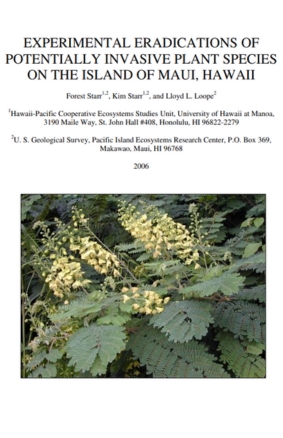
This detailed USGS and University of Hawaiʻi report documents a one-year project aimed at testing the feasibility of eradicating 14 invasive plant species from Maui. The report breaks down site surveys, eradication trials, complications (e.g., seed banks, permission issues), and results for each species. It includes maps, species-specific case studies, and data visualizations, making it an excellent real-world resource for understanding ecological management and scientific fieldwork in Hawaiʻi.

Students and educators can use this report to:
Analyze species profiles and identify what made some eradication efforts successful and others unsuccessful.
Compare GIS maps and land use summaries (p. 4, 17) to understand species spread.
Evaluate ecological trade-offs in management decisions using the report’s success metrics (e.g., size of infestation vs. control success, p. 8–9).
Simulate a conservation decision-making process by roleplaying as MISC or USGS staff evaluating new invasive plant threats.
Design a “rapid response” strategy using data tables (pp. 4–5) that identify where issues like landowner permission or seed banks halted efforts.
Invasive species ecology and field eradication methods
Biogeography and habitat-based vulnerability in Hawaiʻi
Decision-making in conservation under resource limitations
Data-driven mapping and monitoring (GPS, remote sensing, GIS)
Seed bank and biomass dynamics in ecosystem management
Local conservation partnerships (MISC, USGS, UH) in action
Maui-specific invasive species profiles and ecological impacts