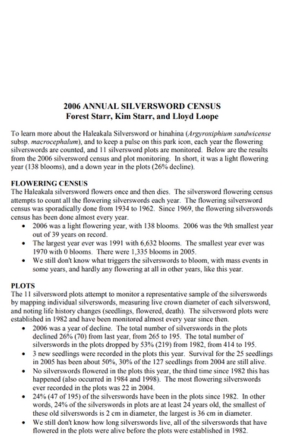
This update summarizes the 2006 Haleakalā Silversword (ʻāhinahina, Argyroxiphium sandwicense subsp. macrocephalum) census in Haleakalā National Park. With only 138 blooms recorded, it was one of the lowest flowering years on record. The report includes detailed data from 11 long-term monitoring plots, offering insights into seedling survival, plant longevity, and population decline. Students can examine how environmental variability affects a rare endemic species, and why long-term monitoring is key to conservation.

Educators and students can use this report to:
Interpret bar graphs and trend data from 1934–2006 (see charts on p. 2)
Compare population change over time using the plot totals
Discuss reasons for population decline, including environmental triggers and seedling mortality
Model conservation decision-making based on incomplete data (e.g., unknown triggers of blooming)
Suggested classroom activities:
Create a time series plot using flowering totals
Estimate seedling survival rates and make predictions for future populations
Debate how to prioritize species for conservation when causes of decline are unclear
Endangered species biology
Native Hawaiian alpine ecosystems
Long-term ecological monitoring
Population dynamics and seedling survival
Scientific data interpretation and conservation analysis
Haleakalā National Park flora