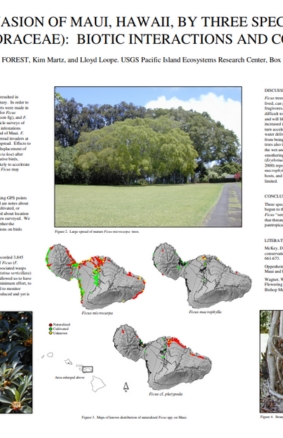
This one-page research poster summarizes the history, spread, and ecological impact of three invasive Ficus species on Maui: Ficus microcarpa, F. cf. platypoda, and F. macrophylla. Originally introduced to enhance watershed cover, these species became naturalized after their specific wasp pollinators were introduced. The report details the consequences of their spread—including infrastructure damage and smothering of native trees—and provides island-wide distribution maps and field observations.

Students and educators can:
Analyze distribution maps to assess spread patterns across Maui (see three maps on poster).
Discuss ecological consequences of plant–pollinator introductions and frugivore-assisted dispersal.
Model potential spread zones based on seed dispersal, habitat suitability, and human influence.
Debate invasive species management through the lens of historical introductions and unintended consequences.
Suggested activities:
Map local tree species and compare their ecological roles to invasive Ficus.
Research and present on pollination mutualisms (e.g., Ficus–wasp interaction).
Simulate policy decisions about tree introduction and removal in Hawaiian communities.
Invasive species ecology in Hawaiʻi
Mutualisms: pollination and dispersal
Frugivore interactions and unintended ecological cascades
Infrastructure damage from root systems
Field methods: GPS transects, naturalization status
Conservation decision-making and early detection