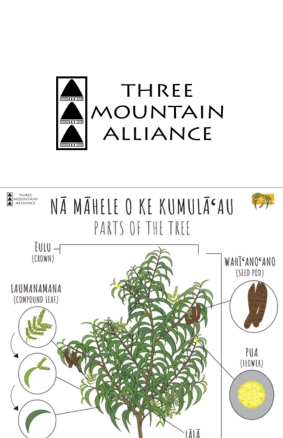
This downloadable diagram + worksheet packet explores the structure of the native koa (Acacia koa) tree. Students receive a detailed, colorable diagram labeled in ʻōlelo Hawaiʻi (e.g., kumu, lālā, puʻu‘puʻu) and matching worksheets to fill in definitions and reinforce vocabulary—helping learners connect botanical knowledge with cultural naming conventions and observations.

Label the tree: Use the provided ʻōlelo Hawaiʻi terms to identify parts (roots, trunk, compound leaf, phyllode, flower, seed pod, nodules).
Color & define: Students color the diagram and complete matching worksheets using term-definition pages.
Discussion prompts: Explore koa’s ecological role—like nitrogen fixation via root nodules and seed pod dispersal.
Comparative botany: Compare koa tree parts with those of other native species (like lehua, ʻaʻaliʻi) using similar charts in the Nā Māhele series.
Plant anatomy in ʻōlelo Hawaiʻi and science terminology
Legume biology: nitrogen‐fixing root nodules and seed pod formation
Cultural‐scientific integration: blending Hawaiian naming traditions with botanical learning
Field identification skills: morphological awareness for ecological observation