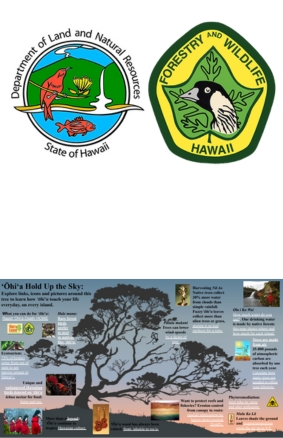
This visually engaging and interactive poster illustrates the ecological, cultural, and economic significance of ʻōhiʻa trees across Hawaiʻi. Viewers explore icons and embedded links on the poster to learn how ʻōhiʻa forests influence freshwater supply, bird habitat, wind protection, erosion control, cultural expression, and climate mitigation. It serves as both a standalone educational tool and an interactive digital learning resource designed for learners of all ages.

Students and educators can:
Explore each icon on the poster to engage with short lessons or multimedia on topics such as endemic birds, climate, water, and Hawaiian culture.
Journal reflections: After exploring each link, students describe how ʻōhiʻa affects life on their island—through water, birds, or climate.
Calculate carbon storage: Use the prompt on the poster to estimate how many ʻōhiʻa trees would offset a household’s annual carbon output.
Design their own “eco-tree” posters inspired by the ʻōhiʻa layout, linking real science and traditional knowledge.
Native tree ecosystem services:
🌧️ Cloud water capture: ʻōhiʻa can collect 30% more water from clouds than rainfall alone.
💧 Watershed health: native forests help produce clean drinking water across islands.
🐦 Bird habitat: endemic species like the ʻiʻiwi rely on ʻōhiʻa nectar and nesting habitat.
🌬️ Wind buffering: canopies reduce wind speeds by half.
🌿 Cooling effect: evapotranspiration from ʻōhiʻa leaves can cool air up to 9°F.
🌊 Erosion prevention: rainfall slowed by ʻōhiʻa leaves reduces erosion by 20–60%.
🌱 Carbon absorption: each tree captures 35–800 lbs of CO₂ annually.
☣️ Phytoremediation: ʻōhiʻa absorb and alter pollutants.
🎨 Cultural value: inspiration for Hawaiian legends, hula, and tools (e.g., ʻukulele, waʻa).
🐤 Ecotourism: 73% of birders visit Hawaiʻi to see native birds supported by ʻōhiʻa forests.