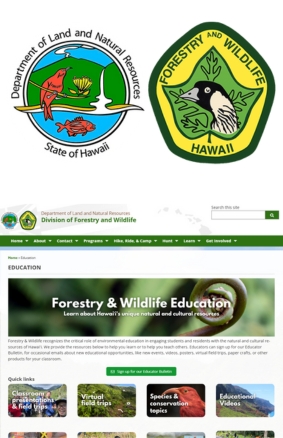
DLNR’s Division of Forestry & Wildlife emphasizes the importance of environmental education throughout Hawaiʻi. Their Education page offers a diverse suite of learning materials: classroom presentations, field trips (in-person & virtual), videos, crafts/activities, curricula, posters, digital wallpapers, species & ecosystem profiles, and volunteer opportunities—all designed to engage students with native and cultural resources.
Classroom Presentations & Field Trips: Schedule educators to lead lessons on native species, watersheds, invasive species, wildfire, and conservation careers.
Virtual Field Trips: Interactive 360° tours (e.g., Snail Lab, Pia Valley, Kaniakapūpū, wetlands, wildlife sanctuaries) aligned with NGSS and Hawaiian educational standards.
Videos: Includes ‘Ike Kaiāulu cultural knowledge series, documentaries, short cultural/ecological films, and student or staff video projects.
Activities & Crafts: These include downloadable finger puppets, masks, coloring sheets, board games, and holiday crafts featuring native birds, snails, and plants.
Curricula: Teacher guides for Nēnē, endangered birds, Moanalua Granite Garden (Project Aloha ʻĀina), Hōʻike o Haleakalā, wildfire prevention workbooks, Enviro-strategies like the “Way of the Wedgie,” and “Natural Inquirer” middle-school sets.
Posters & Wallpapers: Free classroom posters, stickers, and digital backgrounds featuring species like forest birds, snails, wetlands, ʻōpe‘ape‘a; requestable by educators
Native species: mana‘o about forest birds, snails, bats, plants, and more.
Ecosystem science: watersheds, wetlands, forests, wildfire, invasive species.
Cultural connections: Hawaiian knowledge of land, island history, and stewardship, highlighted in video and curriculum materials.
STEAM integration: art, data collection, environment-based projects, mapping, inquiry.
Standards-aligned learning: matches NGSS, Nā Hopena Aʻo, and DOE ʻĀina Aloha K–12 competencies.