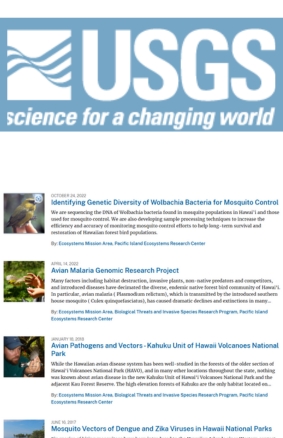
Disease Ecology by the Pacific Island Ecosystems Research Center
Resource Title: Disease Ecology | U.S. Geological Survey
Organization: United States Geological Survey
Description:

The Disease Ecology program at the U.S. Geological Survey's Pacific Island Ecosystems Research Center (PIERC) focuses on how diseases and their vectors affect both wildlife and human health across Hawai‘i and other Pacific island ecosystems. It highlights the introduction of mosquito-borne avian malaria and pox virus—which have drastically impacted endemic Hawaiian birds—and models the risk of emerging human diseases like chikungunya and West Nile virus.


Target Audience: Educators, Facilitators, High School, College
Instructional Roles: Enrichment, Main lesson
Environment: Online only (e.g. interactive map)
Content Type: STEM investigation
Type Of Engagement: Investigate, Reflect
Format: Webpage
Activity:
  • Collecting and analyzing large spatial and temporal datasets on avian malaria, pox virus, and mosquito vectors across Hawai‘i, American Samoa, and other Pacific islands
  • Integrating genetic studies (hosts, parasites, vectors) with epidemiological modeling to forecast disease prevalence and vector distributions
  • Developing predictive tools (e.g., epidemiological and spatial models) that support strategic decision-making and adaptive management for conservation of endangered species
Topics Covered:
  • Avian disease ecology: Transmission dynamics of avian malaria and avipoxvirus in native forest birds.
  • Vector ecology: Mosquito population dynamics and their role in disease spread.
  • Genetic epidemiology: Host susceptibility, parasite virulence, and vector competence.
  • Emerging diseases: Risks from chikungunya, West Nile virus, and other novel pathogens.
  • Modeling and spatial epidemiology: Use of datasets to predict disease spread and support conservation strategies.

Have a question, found an issue, or just want to connect?
Reach out to us anytime. We're here to help.