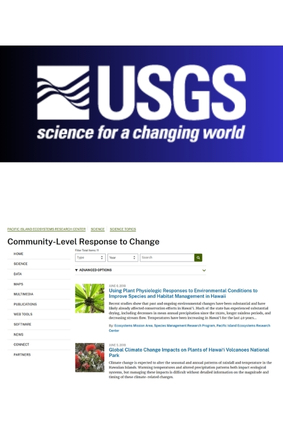
This USGS PIERC portal highlights ongoing research on how Hawaiian ecosystems—especially forests and plant communities—are responding at the community level to environmental shifts. Focus areas include climatic changes (e.g., drying trends, elevated temperatures), invasive species dynamics, and innovative monitoring approaches like plant physiology measures and environmental DNA (eDNA). There are strong links to climate-informed conservation strategies in Hawaiʻi.

Water-Stress & Plant Growth Monitoring
Using methods from PIERC’s plant physiologic response project, students can monitor stem growth or leaf water potential of native species (e.g., ʻōhiʻa) alongside local weather data.
Hypothesize how changes in moisture or temperature might affect plant community health.
eDNA Community Snapshot
Collect soil or water samples from a native forest in Hawaiʻi (e.g., Hakalau, Waimea) and send to a lab (or classroom micro-lab) for eDNA analysis.
Compare baseline biodiversity to documented native/invasive presence and discuss monitoring advantages of eDNA.
Modeling Future Vegetation Change
Introduce students to PIERC’s mapping of plant shifts from tools like satellite imagery (e.g., Lāna‘i study).
Have learners interpret before-and-after vegetation maps or create simple models predicting native/non-native composition under projected warming scenarios/
Species Vulnerability Case Study
Assign research on species at risk from changing temperature regimes—like montane plants or forest birds (e.g., Hawaiian forest birds restricted by malaria limits).
Develop adaptation strategies such as microrefugia, assisted migrations, or predator/invasive control actions.
Stakeholder Science Fair
Reflecting PIERC’s collaborative approach, students design “research pitches” combining community data, climate projections, and monitoring tools.
Present to local stakeholders (DLNR, DOFAW, watershed groups), simulating how science informs land and forest management.
Community-level ecological responses to climate change and drought in Hawaiʻi
Plant physiological measurements and growth monitoring
Cutting-edge biodiversity monitoring: environmental DNA methods
Remote sensing and spatial modeling of vegetation change (e.g., Lāna‘i mapping)
Vulnerability assessments and adaptation strategies for native Hawaiian flora and fauna
Science–management integration: informing real-world conservation practices