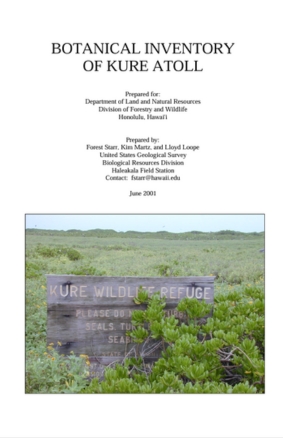
This survey documents the vascular plant species present on Green Island within Kure Atoll—part of Papahānaumokuākea—conducted in May 2001. A total of 81 species were recorded, including several rare native taxa and numerous new naturalized or non-native introductions. The report offers baseline data crucial for native plant conservation, biosecurity monitoring, and management within one of the most remote Hawaiian ecosystems.
Species Inventory Walkthrough Photo Comparison
Using photos, students identify plants like Ipomoea pes-caprae and Lipochaeta integrifolia in situ.
Compare historical inventory to current presence—discuss plant persistence or disappearance.
Range Extension Analysis
Analyze which non-native plants were recorded for the first time (e.g., Buddleia davidii, Noronhia emarginata).
Map their introduction routes and evaluate management strategies within Kure Atoll.
Native vs. Non-Native Plant Debate
Using species lists as a base, students debate pros and cons of selected non-natives—should some be removed, tolerated, or even beneficial?
Seabird-Plant Interaction Study
Explore how plant cover affects seabird nesting (e.g., monk seals or albatross rookeries).
Design an observational study linking vegetation types to wildlife use.
Baseline Data Role-Play
Students role-play as botanists or conservation managers reviewing the 2001 inventory and discussing monitoring needs—especially for rare natives and invasive threats.
Remote Hawaiian island floristic surveys
Vascular plant taxonomy, including rare natives and novel introductions
Biosecurity and invasive species pathways
Ecosystem monitoring and baseline data interpretation
Plant–wildlife ecological relationships (coastal vegetation & seabirds)
Restoration and management planning for Northwestern Hawaiian Islands