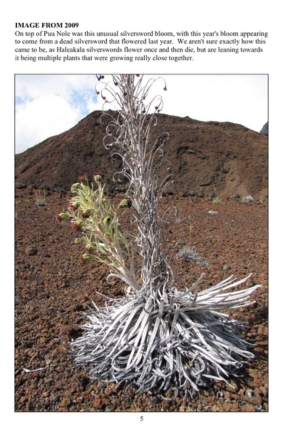
Low Flowering Year: Only 158 Haleakalā Silversword individuals were recorded flowering—the lowest reported flowering count for the period.
Population Decline: A 12% decrease in population density within monitoring plots was observed, continuing the downward trend (following a 22% drop in 2007–2008).
Plot Data: Of 414 plants recorded in 1982, only 111 remained by 2009—a 73% decline over the study period.
No New Seedlings: No new seedlings survived in the monitoring plots during 2009, and those established in previous years continued to decline.
Critical Demographic Data: Offers quantitative insight into population trends vital for endangered-species management.
Recovery Strategy Tool: Helps guide resource managers in refining habitat protection, pollinator support, and invasive species control.
Field for Academic Use: Serves as a compelling case study in population dynamics, conservation biology, and ecosystem management.
Monitored Since 1982: Long-term population assessment across 11 permanent plots, tracking individual plants—including flowering status, seedling emergence, and plant mortality.
Threat Factors: The report links declining populations to reduced pollination (due to potential Allee effects), invasive ants predating pollinators, herbivory from rodents, slugs, drought, and the effects of climate change.
Ecosystem Restoration Efforts: Notes ongoing species recovery steps by Haleakalā National Park and National Tropical Botanical Garden, including fencing, outplanting, and seed collection initiatives.